The excellent diving conditions continued as we head out for the fourth boat dive in the last week.
Blackhead is not renowned for it's clear diving conditions, but today we can see the reef from the boat.
With 8 divers on board, we have plenty of people to complete both Marine Debris surveys and a Reef Life Survey. This is my first RLS for over 12 months, and I am as rusty as the old pick anchor I tie the transect line off too. It is beautiful conditions, 22deg, 15m visibility, but hardly a fish to be seen, unless you count the scad, the parma and the mado...which Brian and I try in vein to do accurately. At 18m, this reef is remarkably repetitive. The lack of fish diversity is made up for by the corals, sponges and other benthic life. Snapper Rock has a variety of small plate and encrusting corals and unusual sponges, unlike anything we see in the south. Ascidians and sea stars, yellow nudibranchs and large wobbegongs hiding in the crevices make for an interesting dive. The debris crew recover a fair bit of fishing debris, as usual on this site, and JD brings up a nice reef anchor.
After a quick visit in at Wallabi Point, we head south to Redhead Gutters. Rachel and I do another RLS, while the others search for debris. This reef is shallower, at 11m, has sandy gutters, kelp covered reef and some overhangs. The fish life is again, fairly bland, apart from two very exciting species - two sub-adult black cod and one eastern devil fish hiding in the over-hangs. Masses of bulls eyes congregate in a small cave, and the other usual suspects cruise by in large numbers - scad, mado, and the girdled parma. I also see a very sweet Pseudoanthias squammipinnis. No debris was found on the transects, but a bundle of hooks and swivels were recovered by Heather. The water was 23deg, and we had a pleasant dive of 51 minutes. The water was more turbulent here, with about 7m visibility.
Friday, April 19, 2013

Seal Rocks 7th April 2013
Excellent weather / water conditions allowed us to dive Little and Big Seal Rocks in near perfect visibility. Our first dive was Little Rock, where we were disappointed to see three spearfishers within the sanctuary zone. "only looking" was their response to our questions. mmm, dubious.
We anchored on the western ledge in 13m of water. A strong current saw the anchor drag all the way to the southern gutter, where we diligently ran our 100m transect, found one soft lure, then ran out of time/air due to the physical exertion required to make any headway in the current. The area was void of fish (who were off in the sheltered areas no doubt!) but I saw some nice nudibranchs, interesting benthic life, and the warm, clear water was most enjoyable.
.JPG)
Gorgonian Coral at Little Seal Rock.
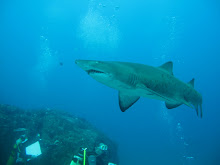
We motored over to Big Rock, where we came upon another boat of spearos, who were also 'only looking'. What a pity the government has cut funding to Marine Parks. These people should be fined every time they enter a pink zone with fully rigged spear-guns. Nick jumped in while we had our interval, and tucked in behind the island, the current was no issue here. After a lengthy break, watching a large pod of common dolphins cruise by, a turtle pop up down in the current and sharks feeding on the surface, we jumped into the lovely (23deg) clear water, and landed in the gutter, where at least 50 grey nurse sharks loitered around their favorite overhang. Suzanne, Dana and I were thrilled to be circled by the resident loggerhead, who looked as though he was waiting for a treat. The clear water enabled us to take lots of great shark shots, many of which should be good for the boys at spot a shark. A wonderful dive left us all buzzing for many days to come.
.JPG)
Sharks hanging out in the 'cave'
.JPG)
Suzanne filming resident loggerhead and sharks at Big Seal Rock
.JPG)
Gorgonian Coral at Little Seal Rock.
We motored over to Big Rock, where we came upon another boat of spearos, who were also 'only looking'. What a pity the government has cut funding to Marine Parks. These people should be fined every time they enter a pink zone with fully rigged spear-guns. Nick jumped in while we had our interval, and tucked in behind the island, the current was no issue here. After a lengthy break, watching a large pod of common dolphins cruise by, a turtle pop up down in the current and sharks feeding on the surface, we jumped into the lovely (23deg) clear water, and landed in the gutter, where at least 50 grey nurse sharks loitered around their favorite overhang. Suzanne, Dana and I were thrilled to be circled by the resident loggerhead, who looked as though he was waiting for a treat. The clear water enabled us to take lots of great shark shots, many of which should be good for the boys at spot a shark. A wonderful dive left us all buzzing for many days to come.
.JPG)
Sharks hanging out in the 'cave'
.JPG)
Suzanne filming resident loggerhead and sharks at Big Seal Rock
The Barge / Latitude 6th April 2013
A week of dirty water at Seals forced us to dive off Forster. At the top of the tide, The Barge was chosen for it's resident shark population. Seven GLUG divers entered what appeared to be clear water. At about 20m, the visibility declined, and sharks abounded. Greg and Anita went in search of the perfect shark shot, Anita enjoyed the company of about 8 sharks circling her so closely, she could have stroked them. The rest of us laid 25m tapes and searched for debris. Heather found a stainless steel cable - the remains of a large portion of net that was recovered two years ago. A whopper wobbegong hid below the wreck, waiting in hiding to strike the next likely prey...or divers hand, which ever took it's fancy first! Luckily, no wobbegong attacks this time around. The grey nurses were skittish, and tails could be heard cracking all through the dive. At 23deg, 28m and 30min bottom time, this dive was well worth the effort, despite the poor visibility on the bottom.
After a good dive interval, we dropped in at outer Latitude Reef. Marine debris surveys turned up fishing line and hooks, but the roaming search found lots more - including a couple of large anchors and length of heavy gauge chain which were too big to recover. The water was dirty here, around 5m visibility, but a lovely dive with plenty of fish life, a gorgeous little green turtle and loads of wobbegongs lurking in the kelp. At 18m, 40minutes bottom time was more than enough.
A great day had by all.


Wednesday, April 3, 2013
THE GRAVEYARD/CHARLOTTES REEF – 23rd MARCH 2013
March and April are the best times to dive the mid north coast. The weather
and the waters are still warm and seas are settled which means optimum
visibility. Six members of the Great Lakes Underwater Group (GLUG) left
the jetty with the sun shining and the bar reasonably calm.
At The Graveyard site each took a giant stride off the boat into clear warm water. Peter Trood, Heather Armour and Janne and Tony Moran, to perform transects for two areas whilst Anita and Greg Toland were to do Spot a Shark monitoring using cameras with laser beams. The tapes were to a rock and ran the obligatory 25 metres in a straight line, then the divers slowly swam back along to monitor for marine debris. An old anchor with a chain was found on the first transect but nothing in the opposite direction so random searches were commenced. Later a fishing rod and a fishing lure was found amongst the kelp. Also spotted were a large numb ray and a Port Jackson Shark but no grey nurse sharks. Total dive time was 46 minutes with a maximum depth of 17.8 metres.

tony laying the transect line at Graveyards
After a surface interval the boat motored over to the second site, Charlottes Reef just off Shelly Beach. The water was shallower this dive so a slight current was evident and the visibility was down. Again transects were taken with no marine debris found. After a short time however near the rocks fishing line, sinkers, hooks, rope and plastic netting were retrieved as well as a surfboard fin. A large anchor with chain was sighted but could not be retrieved so several photographs were taken. Several house bricks were also sighted. Three more numb rays were lying amongst the rocks. Total dive time was 52 minutes with a maximum depth of 9.8 metres. Water temperature was 21 degrees.

mating numb-rays. HEATHER ARMOUR
At The Graveyard site each took a giant stride off the boat into clear warm water. Peter Trood, Heather Armour and Janne and Tony Moran, to perform transects for two areas whilst Anita and Greg Toland were to do Spot a Shark monitoring using cameras with laser beams. The tapes were to a rock and ran the obligatory 25 metres in a straight line, then the divers slowly swam back along to monitor for marine debris. An old anchor with a chain was found on the first transect but nothing in the opposite direction so random searches were commenced. Later a fishing rod and a fishing lure was found amongst the kelp. Also spotted were a large numb ray and a Port Jackson Shark but no grey nurse sharks. Total dive time was 46 minutes with a maximum depth of 17.8 metres.

tony laying the transect line at Graveyards
After a surface interval the boat motored over to the second site, Charlottes Reef just off Shelly Beach. The water was shallower this dive so a slight current was evident and the visibility was down. Again transects were taken with no marine debris found. After a short time however near the rocks fishing line, sinkers, hooks, rope and plastic netting were retrieved as well as a surfboard fin. A large anchor with chain was sighted but could not be retrieved so several photographs were taken. Several house bricks were also sighted. Three more numb rays were lying amongst the rocks. Total dive time was 52 minutes with a maximum depth of 9.8 metres. Water temperature was 21 degrees.

mating numb-rays. HEATHER ARMOUR
Saturday, January 26, 2013
The Baitgrounds - 24th January 2013
With awful conditions on the last GLUG dive, we were all glad to see the water clear up at last. Anita, Tony and I decided to checkout the Baitgrounds and after some minor (some might say major!) technical hitches, we were pleasantly surprised by relatively clear, warm water (variable 10m viz, 22deg). We completed 4x25m transects in quick time on account of there being no debris to collect! The rest of the dive was spent meandering around the inner reef, searching for random marine debris and endangered species. This near-shore reef system is comprised on a number of kelp-covered, elongate reefs that run E-W, surrounded by sand. We were surprised that, given the water temperature, we did not see any grey nurse sharks. This is normally a popular location with nurses. Neither did we see any turtles. Only a large wobbegong and an eagle ray; and lots of brightly coloured juvenile girdled parma, moon wrasse and Gunthers butterfly fish. A pleasant morning was had by all, but we all resolved to revisit the site again soon to check on those sharks!
Monday, November 26, 2012
24th November 2012 The Barge/ Baitgrounds
Fog on the ground in the early morning was a good sign for the day ahead. Dead flat seas made for a smooth ride out to The Barge and ideal conditions to spot dolphins swimming about enjoying themselves.
Descending down the anchor was initially murky but on the seabed the entire barge was visible plus the reef next to it. The Barge was a garbage barge that was sunk deliberately as a dive site. As soon as we reached the anchor a two metre male grey nurse cruised by for a photo opportunity. Another male measuring 2.5 metres also swam passed for our camera. We peered down holes in the barge and performed roaming marine debris surveys. Two stubby beer bottles were found, one was retrieved however the other was inhabited and left behind.
Also sighted were red morwong, jewfish, eastern hula fish, maori wrasse, beardies, sweep, yellowtail scad, traglin, pike, crested morwong, blue grouper, mado, balling catfish, brown catfish, white faced pullers, crimson banded wrasse, yellow catfish, old wives, orange seastars, girdled scalyfin and bullseyes. Maximum depth was 28 metres with a water temperature of 20 degrees.
After a surface interval we headed over to The Baitgrounds. This dive we were able to perform roaming marine debris surveys in straight lines of 25 metres, as the reef was small and surrounded by sand. We soon found a fishing line with two hooks and a sin
 ker (recovered), a sand anchor complete with rope (recovered) and netting with cabling and rope wedged in the rocks, therefore unable to be recovered however photographic evidence was taken.
Two female grey nurses (1.3m and 1.7m) was sighted as well as a juvenile hawksbill turtle, sweep, mado, red morwong, yellowtail scad, balling catfish, old wives, jewfish, eastern hula fish, pike, white faced pullers, girdled scalyfin, maori wrasse, crimson banded wrasse, hawk fish, blue cleaner wrasse, blue grouper, blue damsels, bullseyes, cardinal fish, trumpeters, kelpfish, senator wrasse, Gunters butterfly fish, blue lined kale, eastern smooth boxfish, hard skinned boxfish, numbray, fiddler rays, wobbygong, a school of squid, a port Jackson shark and a port Jackson shark egg case. Maximum depth was 11 metres.
GLUG Members Present – Anita Toland, Greg Toland, Janne Moran, Tony Moran, Rachel Dodd and Heather Armour.
ker (recovered), a sand anchor complete with rope (recovered) and netting with cabling and rope wedged in the rocks, therefore unable to be recovered however photographic evidence was taken.
Two female grey nurses (1.3m and 1.7m) was sighted as well as a juvenile hawksbill turtle, sweep, mado, red morwong, yellowtail scad, balling catfish, old wives, jewfish, eastern hula fish, pike, white faced pullers, girdled scalyfin, maori wrasse, crimson banded wrasse, hawk fish, blue cleaner wrasse, blue grouper, blue damsels, bullseyes, cardinal fish, trumpeters, kelpfish, senator wrasse, Gunters butterfly fish, blue lined kale, eastern smooth boxfish, hard skinned boxfish, numbray, fiddler rays, wobbygong, a school of squid, a port Jackson shark and a port Jackson shark egg case. Maximum depth was 11 metres.
GLUG Members Present – Anita Toland, Greg Toland, Janne Moran, Tony Moran, Rachel Dodd and Heather Armour.

Sunday, November 18, 2012
Sunday, October 21, 2012
Blackhead - 20th October 2012
We set out from Forster marina at 8am through rolling seas, enjoying the company of whales and their calves all the way to Snapper Reef, about 45 minutes north of Forster.
The morning was warm and sunny, with a blustery Nor-wester blowing strongly by the time we entered the water at 9:30am. Although we passed wracks of red-weed on our journey, the water was pleasantly clear, with around 10-15m visibility. Anchoring in barren reef at 16m, we proceeded with our marine debris surveys, finding a reel directly next to the anchor. Our search also turned up two complete fishing rods, only one of which was recovered. We finished our transects and exited the water, loot in hand. John then jumped in and found another couple of rods.
The highlight were the large and inquisitive blue gropers, occasional corals and pretty seastars.
 Left:Rachel and Heather set out the transect line.
The wind had strengthened during our dive, now whipping the sea into white-caps. We headed south and surveyed a reef off Redhead, known as The Ridge. Slightly shallower, this undulating reef had more interesting benthic life, with gorgonian corals, sea tulips, zooanthids and large sponges. No debris to be had (always a good sign!), and not much fish-life to mention, but the whales were peeping and the underwater colours were beautiful. A bit chillier than the first dive, at 17deg, and enjoyed by all, except Zack, who was not feeling too good by this stage.
Our trip back to Forster was the highlight of the day, with a spectacular aerial display by a baby humpback while his mum cruised by, less than 100m from the boat. The hot westerly wind had the mercury pushing 40deg by 1pm, our second heat wave day this spring!
Thanks to John and Zack, from Action Divers, for a very enjoyable morning.
Left:Rachel and Heather set out the transect line.
The wind had strengthened during our dive, now whipping the sea into white-caps. We headed south and surveyed a reef off Redhead, known as The Ridge. Slightly shallower, this undulating reef had more interesting benthic life, with gorgonian corals, sea tulips, zooanthids and large sponges. No debris to be had (always a good sign!), and not much fish-life to mention, but the whales were peeping and the underwater colours were beautiful. A bit chillier than the first dive, at 17deg, and enjoyed by all, except Zack, who was not feeling too good by this stage.
Our trip back to Forster was the highlight of the day, with a spectacular aerial display by a baby humpback while his mum cruised by, less than 100m from the boat. The hot westerly wind had the mercury pushing 40deg by 1pm, our second heat wave day this spring!
Thanks to John and Zack, from Action Divers, for a very enjoyable morning.

Combating Marine Debris
Seven members of GLUG (Great Lakes Underwater Group) spent Friday 28th September cleaning up the Tuncurry break wall from the Rock Pool to under Forster Bridge.
The group had a bag each but this was soon filled with lots of debris ranging from fishing tackle, line, rods and lures, to chairs, plastic pipe, bottles and even a mobile phone.
The group carries out this clean-up twice yearly and were very disappointed to the huge amount of man-made debris that finds its way into our magnificent waterway.
There was debris from the recreational fishermen as well as a lot of pipe, rope and long line gear from the fishing fleet located along the edge.
Generally, people are becoming much more aware of the need to preserve our water ways for our future generations. There are still a few who don’t seem to care. Just because you can’t see it doesn’t mean it isn’t there and that it doesn’t have a huge impact on the environment. It does and time will only tell how much.
Anita Toland
Sunday, September 16, 2012
Little Seal & Skeleton Rocks
16-09-2012
Members of GLUG present:-
Isabelle Strachan, John Connolly, Greg and Anita Toland
After a week of good weather and westerly winds blowing at Forster the group was hoping to have relatively good dive conditions. We were picked up from Boat Harbour at Seal Rocks just after 9am. The trip out with Nick was a bit rough once we passed the protection of Sugarloaf Point with a roll coming in from the South.
Our first dive was a Little Seals. We anchored on the western side near the whitewash. When we descended the anchor line there was a 2.5m female GNS right in front of us. We managed to take a few photos but alas the visibility was very poor and we didn’t manage to capture any of its markings.
We laid out the transects in a North South alignment and only found an old listening device rod which was successfully retrieved. We were actually surprised to see so many good size drummer and bream and snapper cruising around the rock. There were heaps of wrasse and the usual bullseyes and heaps of one spot pullers. The fish seem to be building up in numbers very quickly as a result of Little Seals being in the marine park. The best part of the dive was the magnificent whale song which accompanied us the entire dive.
We managed to stay in for 35 minutes before we retreated to the boat for a hot soup as the water was a chilly 16 degrees.
After a move to Skeleton Rock and a change of tanks we were back into the cold conditions. Again the visibility was very poor with heaps of plankton in the water. We carried out our four 25m marine debris surveys at a depth of 10 and 15 metres. We found nothing along the transect lines or on our roaming search. We managed to circumnavigate the bommie and were treated with the sighting of the resident large loggerhead turtle.
Anita Toland
Friday, June 1, 2012
World Oceans Day - 2012. Clean up Forster Breakwall
June 8th is World Oceans Day, the UN-designated day for the global community to celebrate and take action for our shared ocean. One of the greatest threats to the ocean is also one of the most insidious because chances are it’s so mundane you don’t even notice it. Look around you right now: how much plastic do you see?
The ocean is downstream from all of us so no matter where we live, so we can all help address the issue of plastic pollution in the ocean. Each year a huge amount of plastic eventually makes it into coastal waters and harms ocean life. Many animals such as seabirds, sea turtles, dolphins, and whales die every year from plastic entanglement or starvation because they fill up their stomachs on plastic they mistake for food. Take action for World Oceans Day and prevent plastic from harming ocean wildlife!
Reduce plastic use . Help stop plastic pollution at its source! As consumers, we each have the power to reduce demand. And if you encourage family and friends to do the same, the more the more good we can do to keep the ocean clean and safe. Here are a few disposable plastic products everyone can reduce in our daily lives:
Plastic water bottles. Invest in a reusable water bottle, and filter water if necessary. Help the ocean and save money; it’s a win-win for you and the blue. On average, Americans now use 4 plastic water bottles a day—the highest ever recorded! Let’s turn the tide against wasteful plastic consumption.
Plastic bags. People use nearly 1 trillion plastic bags each year, and unfortunately, many of those end up ingested by sea turtles that mistake plastic for jellyfish. Remember to bring a reusable bag for food (including vegetables) and other shopping and save a life!
Straws, cups to-go, food containers, and utensils. Bring your own reusable products like mugs when you get coffee and take a pass on the plastic utensils when you get take-out food. And if you must have a straw, there a number affordable options!
Be aware of packaging. Pay attention to how much incidental plastic that comes with what you buy—your candy, headphones, pens, etc., all come in plastic packaging. Strive to cut down on your daily plastic consumption and reward corporations that package responsibly!
Act for World Oceans Day!
Come along and help with our Underwater CleanUp - Meet at Forster Marina at 11am on Friday 8th June. Call 65917301 for more information.
Hold a ‘Switch for the Sea’ contest! Ask friends and family to switch one of their disposable plastic habits for a sustainable, ocean-friendly one: such as bringing reusable food containers from home when eating out for your ‘doggie bag.’
Come along and help with our Underwater CleanUp - Meet at Forster Marina at 11am on Friday 8th June. Call 65917301 for more information.
Hold a ‘Switch for the Sea’ contest! Ask friends and family to switch one of their disposable plastic habits for a sustainable, ocean-friendly one: such as bringing reusable food containers from home when eating out for your ‘doggie bag.’
Organize an aquatic clean-up! Head out to your nearest and dearest body of water with some friends and pick up all the trash you find. You’ll be surprised at how much of it is plastic.
Ban the bag in your town. Many communities around the world are banning plastic bags from being used at their stores. Learn how to start a campaign to stop plastic bags use in your town!
There are hundreds of events being held all over the world, find one near you and celebrate with a purpose this World Oceans Day! You can also go the extra mile and organize an event yourself using ideas and free materials provided at WorldOceansDay.org!
Friday, May 25, 2012
Dive Trip to North Latitude and Bennett’s Bommie, 5th May, 2012
The dive started out with a bit of confusion despite the magnificent morning weather as both Suzanne and Peter turned up as extras to dive with Forster Dive Centre. Nick had indicated by phone that morning that there was room for two extras but once the boat was loaded he realized that other non-GLUG divers had brought friends unannounced to dive, some being in the extra extra large category. So although both Suzanne and Pete tried to pull out, the very gracious Rachel and Heather insisted that they would give their dive up and go out the next day with Nick.
So after an embarrassing start and a farewell from Rachel and Heather, the group headed out to Latitude. The dive buddy groups for the first dive were Suzanne, Tony and Anita; and Brian and Peter. Despite the sun fading before the first dive the visibility was not too bad, about 7- 9m. Due to a fairly strong current we decided to do a roaming debris survey and collection rather than use transect lines. The findings comprised a single aluminium can and an anchor was found by the non-GLUG group but was left in situ. The habitat comprised mostly of kelp-covered rock. In terms of fish species there were plenty of bait fish, red morwong, a leather jacket, a single striped catfish, lots of blue grouper, wobbegongs, crimson-banded and other wrasses and a tropical long nose butterfly. The highlight species were several - a small green turtle and a beautiful large spotted eagle ray with a tail length of at least 2 metres. The maximum depth of the dive was 19-21m and dive time was around 50 minutes.
The surface interval was not very pleasant. The sun was gone and the wind had sprung up and there were some seriously noisy chundering companions from the non-GLUG contingent. They were very sick and not very happy, but spent most of their time bouncing around in the water while the non-sickies tried to ignore their noises and chunder and pretend to enjoy the lovely soup, bikkies and lollies provided by Nick. There was much discussion as to whether the second dive could go ahead or whether we should offload the off-colour divers first, but we ended up at Bennett’s Head bommy and all went below.
Dive pairs consisted of Janne and Tony, Brian and Peter; and Suzanne and Anita. The habitat was again kelp-covered rock on a sand floor base. The visibility was poor (2-5m max) and the current was strong. Again we did a roaming debris collection and I found a broken crab trap. Again there were plenty of baitfish around and lots of ornate wobbegongs, a few Port Jackson sharks and fiddler rays. I found a beautiful gastropod buried in the shell and soon found out how razor-sharp is the edge of the shell-opening. Max. depth was around 11m and dive time around 50 minutes, but the decreasing visibility and increasing current made heading for the top a more desirable option.
Back on board dear Nick experienced boat problems as the steering broke and he did a very professional job steering us through the bar using his reverse gear when necessary. Back at the Dive Centre the gear washing and hot shower services were most appreciated and our dear Heather and Rachel had returned to greet us and show the fruits of their labour. They had snorkeled in Breckenridge Channel and collected more debris than us! Well done girls – they also stayed on for the scrumptious GLUG BBQ organized by Anita and Janne.
Friday, May 18, 2012
Big Seal Rock, 12 May 2012
BIG SEAL ROCK -SATURDAY 12TH MAY 2012
DIVE 1 - SOUTH EAST CORNER -Five members of the Great Lakes Underwater Group joined Action Divers to complete marine debris surveys, monitor grey nurse sharks and record fish life at Seal Rocks. A chilly wind was from the southwest meant we could not anchor too close so a shot line was put over the stern directly into the gutter.
Anita and I were first in the water and we were met by approximately forty males grey nurse sharks, many juveniles, and twenty females. Quite a few carried scars and one female had tackle trailing from her mouth – the hook way down in her stomach. She was in poor condition. Two others had thick monofilament line (long-line) with large stainless steel hooks and another had the top of its tail chopped off. Fortunately John managed to remove a hook from one individual, but it is frustrating to not be able to help the others.
A random marine debris survey was conducted as at a depth of 20 metres it was too deep to carry out transects, and one large stainless fishing hook with a trace was found and removed.
A fish identification survey recorded blue grouper, red morwong, comb wrasse, maori wrasse, crimson banded wrasse, girdled parma, common and small scale bullseyes, old wives, Moorish idols, half banded sea perch, sweep, mado, wobbegongs, bream, snapper, red rock cods, pufferfish, white cheeked scalyfin, kingfish, one spot pullers, black reef leatherjacket, moray eels and a free swimming older large loggerhead turtle.
The conditions were pleasant with a water temperature of 22 degrees and visibility of 15 metres.
DIVE 2 - WESTERN GUTTER – This dive was to 14 metres which meant Jordon and Brian were able to conduct marine debris transects. They did not find any debris however Anita found another large stainless steel hook with monofilament line buried in the sand on the north east gutter which she took back to the boat with her.
Approximately twenty grey nurse sharks were sighted with one female trailing a long section of fishing line covered in growth. Also recorded were surgeon fish, blue grouper, red morwong, kelp fish, comb wrasse, maori wrasse, crimson banded wrasse, girdled parma, common and small scale bullseyes, old wives, half banded sea perch, sweep, pike, yellowtail scad, wobbygongs, Port Jackson shark, bream, mado, stripeys, pufferfish, blackspot goatfish, luderick, blue damsels, one spot pullers, crested morwong, red morwong, bream, snapper, moray eels, six spine leatherjacket (male and female), Moorish idols, Lord Howe Island butterfly fish, black spot goatfish, blue and yellow fusilier, eastern hulafish and red rock cod.
The water temperature was 22 degrees with visibility at 8 metres however we began to feel the cold and headed back up the anchor to decompress whilst watching a large school of sweep swim about under the boat in the sunlight.
HEATHER ARMOUR.
Saturday, April 28, 2012
Anzac Day Dive
The Pinnacle, Cape Hawke. The day started with a fresh sou-westerly wind and clear skies. Six GLUG members boarded for the first dive of our new project Monitoring marine debris in the Great Lakes Area. We were heading to deep water site, the Pinnacle for some threatened species work, followed by a training dive at Latitude Reef. After a few delays in the harbour, Nick, skipper at Forster Dive Centre, chartered us out to the mooring at the Pinnacle. The water was a balmy 23deg on the surface, 19deg below, and visibility was good - 10-15m. We were there to document the local grey nurse shark and black cod populations, as well as check the area for marine debris. The site is deep >30m, so transect work was out of the question. Unfortunately, Heather had trouble with her weight belt and bcd, and had to abort the dive all together. The rest of us completed a roaming search for marine debris, and documented the fish life present. We checked the latest haunts for the cod family, spotting plenty of snapper, mulloway and kingies on the way, as well as the resident (massive) black ray. After a few 'hiccups' with insects in regulators & near choking events, we made our way back to the mooring line, where a lovely black cod was hanging in the dark crevices. Greg found an old rope and tangled monofilament bundle, which we removed from the site. No sharks were seen. Lesson of the day - always purge your regs before descending, you never know what you might find! Dive Details: 33.8m, 29min, 19-23deg

Tangled mess of rope and monofilament found at 37m at the Pinnacle. Photo by Greg Toland

Young female grey nurse shark with fishing line trailing from her mouth at Latitude Reef. Photo by Greg Toland
Latitude Reef, Cape Hawke. Jordan, Kaitlyn and I jumped in to 10m, the top of Latitude Reef, which runs due East-West, with a nice kelp bed on the top, and reef wall to the north that drops down to about 20m. I was showing Kaitlyn and Jordan the Marine Debris Method, so we stayed up on top, and ran two 25m tapes due east, checking for marine debris in a 5m band along each tape. Kaitlyn made the only find, a stainless swivel. We had to contend with a bit of swell, which always makes the method more of a challenge, but the trainees did a great job. To top it off, we had four grey nurses swim through the transect line right at the end, one of which was a lovely large female (2.5-3m). We then bumped into Greg and Colin and swam back along the wall to the cod hole, where at least 10 grey nurse sharks were cruising. Greg took around 80 shots of the sharks with the lasers (used to size each animal accurately) for the Spot a Shark team, and I tried to battle with the surge and get some shots for spot a shark. We spotted one small female with a long piece of line trailing from her mouth - a common sight in our local grey nurse shark population. Greg also spotted a green turtle, and Rob, the dive master, spotted a small hawksbill turtle. I found another debris item on our swim - a piece of metal bar, probably from an anchor. Heather had more trouble with her gear, and again had to abort the dive half way through the transect. 'I should not have got out of bed', she said back on board! A great day for our first dive, and with the water looking better than it has in two years, we may be in for some busy weekends! Dive Details: 16.4m, 36min, 19 deg. I am out of action for a while after my choking incident - inhaled a full-grown cockroach at 33m, and now have pneumonia! Ah, the joys of diving :)
Tuesday, August 17, 2010
The Barge / The Colours, 24th July 2010
Some dives are just meant to be just wonderful. As we stood geared up ready to plunge into the cool 16 degrees water the GLUG group was treated to a huge humpback whale breaching at the stern of the boat. Feeling elated we made our way down to the barge. It is an old garbage barge lying in 28 metres of water a couple kilometres off the entrance to Wallis Lake.
Even though the visibility was around 5m there was lots to see. A few huge old snapper were cruising a couple metres off the bottom while a school of small scale bulls-eyes hid under the bow of the wreck.
I was fascinated by the enormous school of black and yellow striped balling catfish who were literally balling their way around the edge of the wreck. You could gently pass your hand into the mass and watch your hand being engulfed by the fish.
In the rusty bowels of the wreck was a school of around 20 big mullaway, seemingly hanging in suspended animation.
After our mandatory surface interval, where we compared notes on what each buddy pair saw on the dive we pulled anchor and moved to our second dive location, The Colours. The Colours is just that, a very colourful area of reef in about 10 metres of water off the north end of Mc Brides Beach. The area has lots of sand and kelp covered gutters and it isn’t hard to get lost in the maze of reef structures. Even though there was a lot of surge in the water and the group doing the reef life survey got themselves a bit tangled up there was a great range of fish species to be seen. These included the ever friendly blue groper, a number of colourful senator wrasse, schools of yellowtail scad and lots of rock cale.
Anita Roche
Even though the visibility was around 5m there was lots to see. A few huge old snapper were cruising a couple metres off the bottom while a school of small scale bulls-eyes hid under the bow of the wreck.
I was fascinated by the enormous school of black and yellow striped balling catfish who were literally balling their way around the edge of the wreck. You could gently pass your hand into the mass and watch your hand being engulfed by the fish.
In the rusty bowels of the wreck was a school of around 20 big mullaway, seemingly hanging in suspended animation.
After our mandatory surface interval, where we compared notes on what each buddy pair saw on the dive we pulled anchor and moved to our second dive location, The Colours. The Colours is just that, a very colourful area of reef in about 10 metres of water off the north end of Mc Brides Beach. The area has lots of sand and kelp covered gutters and it isn’t hard to get lost in the maze of reef structures. Even though there was a lot of surge in the water and the group doing the reef life survey got themselves a bit tangled up there was a great range of fish species to be seen. These included the ever friendly blue groper, a number of colourful senator wrasse, schools of yellowtail scad and lots of rock cale.
Anita Roche
Monday, August 16, 2010
DIVING WITH THE “SPOT A SHARK” TEAM- 25TH JUNE 2010


The east coast population of Grey Nurse Sharks is listed as Critically Endangered. The Great Lakes Underwater Group (GLUG) are familiar with the “Spot a Shark” program, a non-profit dive community research project that uses photo-identification techniques to monitor grey nurse shark populations on the east coast of Australia.
Club members often send down photos of grey nurse sharks for possible matches. One diver in particular has had a few of her shark photos from Seal Rocks identified as the same sharks sighted at Magic Point or Fish Rock.
Peter Simpson and Sean Barker from “Spot a Shark” were invited up to give a presentation of their work to the members of GLUG and the general public as part of the Great Lakes Marine Discovery Series. The following morning GLUG planned to take them out to Seal Rocks to continue the task and complete some field training for GLUG members. The presentation at Club Forster was well received and both guys were happy to answer any questions about their program. The project is based on non-invasive photographic identification system then identifies and tracks individual grey nurse sharks between key aggregation sites in NSW.
Each shark has a series of pigmentation spots on either side of their body. These markings are unique to each shark. One device they use is two laser pointers attached to their cameras to ascertain the length of the shark. A left facing shark photograph is preferable as each side of a shark is different to the other side. It turns out Seal Rocks is an integral part of the shark migration being half way between Magic Point and Fish Rock.
Divers met at Forster marina early the next day to load up the boat then drove down to Seal Rocks for a short snorkel out to the boat to drop anchor off nearby Big Seal Rock. The water had good visibility and still reasonably comfortable at 19 degrees. Approximately thirty grey nurse sharks were sighted; unfortunately at least three animals had hooks in their mouths or gills. The songs of the whale could be heard throughout the entire dive.
Aside from the sharks also sighted was a large loggerhead turtle, girdled parmas, mado, maori wrasse, comb wrasse, one spot pullers, bulleyes, red morwong, blue and brown grouper, red rock cod, goatfish and a large wobbegong, all duly recorded on slates and photographed for our identification and research work. Total dive time was 40 minutes with a maximum depth of 24.8 metres.
A second dive was done at the same site, as Peter and Sean were more than happy with both the conditions and number of grey nurses. Total dive time was 41 minutes with a maximum depth of 23.3 metres.
HEATHER ARMOUR
Tuesday, June 22, 2010
Shelly Beach, 18th June 2010

Finally the swells subsided enough to allow us to get back in the water. With the last two dives canned because of unfavourable conditions, we were keen to get wet again. Numbers were too low to justify a boat trip to Seals, so April and I trekked over the hill and went for a lovely swim at Shelly Beach. The fish diversity was fantastic, with over 50 species observed in nice clear water. We swam around the point, checking the caves and crevices around the small island rock off the point. In one gutter, there were Ornate and Spotted Wobbegongs, Port Jackson Sharks and stacks of bulls-eyes, along with the beautiful Southern Fusiliers. On our way back, we spotted a couple of Grey Nurse Sharks cruising through the outer gutter. So we nestled ourselves amongst the kelp and tried to get some good photos of them. Meanwhile, April spies a couple of Whitelegg's Weedfish, Heteroclinus whiteleggi. Very cute.
Nearing the shore, a small green turtle dart out from the rocks and flies past us at amazing speed.
What a great way to end a very pleasant dive.
World Oceans Day 2010
This year GLUG hosted a film night at Club Forster, featuring GLUG footage of the local area and the documentary "Byron Underwater". The evening was well attended and enjoyed by all.
"Oceans of Life: choose your favourite; protect your favourite" was the theme for WOD 2010. In keeping with the theme, GLUG also ran a small competition at Forster Library, for local people to choose their favorite local marine animal, as photographed by GLUG members. Voters were asked to select from the following animals: neon damsel, strawberry cod, blue groper, grey nurse shark, ornate wobbegong, loggerhead turtle, green turtle, giant cuttlefish, red rock cod, common stingaree, pineapple fish. The competition was very close, with the green turtle just pipping the others at the post. Equal second was awarded to the grey nurse shark, loggerhead turtle and ornate wobbegong.
A snorkel and mask set, courtesy of Action Divers, was won by Forster resident, Paul Parton.
The green turtle will now be developed into our mascot.
"Oceans of Life: choose your favourite; protect your favourite" was the theme for WOD 2010. In keeping with the theme, GLUG also ran a small competition at Forster Library, for local people to choose their favorite local marine animal, as photographed by GLUG members. Voters were asked to select from the following animals: neon damsel, strawberry cod, blue groper, grey nurse shark, ornate wobbegong, loggerhead turtle, green turtle, giant cuttlefish, red rock cod, common stingaree, pineapple fish. The competition was very close, with the green turtle just pipping the others at the post. Equal second was awarded to the grey nurse shark, loggerhead turtle and ornate wobbegong.
A snorkel and mask set, courtesy of Action Divers, was won by Forster resident, Paul Parton.
The green turtle will now be developed into our mascot.
Sunday, May 9, 2010
ONE MILE GUTTERS/ BENNETT’S HEAD BOMBIE – 26th April 2010

Left: Loggerhead Turtle, Caretta caretta. Photo: Troy Fardell

Above right: Pineapple Fish, Cleidopus gloriamaris. Photo: Troy Fardell
It was the Anzac Day public holiday and nine members of The Great Lakes Underwater Group met up at the Forster marina to load up the boat from Action Divers. Typical of long weekends, the weather was inclement with brisk southerly winds whipping up the seas. The original plan to dive Seal Rocks was revised and we opted for local dives close to the shore.
Isabelle and Peter undertook Reef Life Surveys whilst the other members recorded fish life on slates and digital cameras. The water temperature was still pleasantly warm and due to the southerly the visibility was good. As soon as the divers hit the water at One Mile Gutters they were surrounded by an enormous school of yellow tail scad. Thousands of fish moved as one, circling the divers and often blocking their line of sight. The depth was only 12 metres enabling rays of sunlight to pierce the water and shine on the fish and create brilliant flashes of silver as they darted in the shallow water.
Also recorded were herring cale, bronze-coloured old wives, Moorish idols, turtles, one-spot pullers, girdled parmas, crimson banded wrasse, Maori wrasse, boxfish, moray eels, nudibranches, wobbegongs, luderick, mado, toadfish, pipefish, goatfish, stripeys, flounder, red morwong, neon damsel, pineapple fish and Guenther's butterfly fish. At the entrance to the cave at Bennett’s Head bombie was a large blue grouper waiting for a handout of urchins. Only one item of debris, an electrical insulator, was found. A pod of dolphins followed the boat through the bar.
HEATHER ARMOUR
Subscribe to:
Posts (Atom)